Seafood OEM Manufacturing: The Production Questions Brands Forget to Ask Before Signing a Contract
Quick Answer
Seafood OEM manufacturing involves a brand contracting a specialized seafood processing facility to produce private-label or branded seafood products according to the brand's own recipe, packaging, and quality specifications, rather than the brand operating its own processing facility. Brands evaluating a seafood OEM partner should verify actual production capability and food safety certification for their specific product category, clarify recipe and formulation ownership terms before development begins, and establish clear quality consistency testing protocols, since these fundamentals determine whether an OEM relationship becomes a reliable long-term production partnership or a source of recurring quality and supply disruption.
Operating a seafood processing facility requires substantial capital investment, specialized food safety infrastructure, and regulatory compliance expertise that many brands — particularly those focused on product development, marketing, and distribution — find more efficient to access through an established OEM partner rather than building in-house. This allows brands to focus their own resources on product development, branding, and market growth while leveraging an experienced manufacturer's existing production infrastructure and regulatory compliance systems.
Avoids the substantial capital investment required to build and certify a seafood processing facility
Provides access to established food safety infrastructure and regulatory compliance expertise
Allows brands to focus resources on product development, branding, and market expansion
Offers production flexibility and scalability without the brand carrying fixed manufacturing overhead
Verifying Production Capability for Your Specific Product Category
Seafood OEM manufacturers often specialize in particular product categories or processing methods, and a manufacturer with strong general seafood processing experience may not necessarily have the specific equipment, process expertise, or ingredient sourcing relationships required for a buyer's particular product type. Buyers should verify a candidate manufacturer's actual production experience with products genuinely comparable to their own, not just general seafood processing capability.
| Capability to Verify | Why It Matters | Specific product category experience | General seafood processing experience doesn't guarantee capability with your specific product type | Production capacity and scalability | Confirms the manufacturer can meet both your initial and future volume growth needs | Raw material sourcing relationships | Affects both ingredient quality consistency and supply chain reliability
| Packaging and format capability | Confirms the manufacturer can produce your specific packaging format, not just the product itselfSeafood OEM Manufacturing 03.webp221.95 KBCommunication and Development Process Expectations
Brands should establish clear expectations upfront around the product development timeline, including how many formulation rounds are typically included before finalization, how sample approval works, and what the escalation process looks like if development takes longer than initially anticipated, since seafood formulation — particularly for products requiring specific flavor or texture targets — can involve more iteration than brands sometimes expect going into the relationship.
Clarify how many formulation rounds are included in initial development before additional costs apply
Establish a clear sample approval and sign-off process before production commitments are made
Discuss escalation procedures if development timelines extend beyond initial projections
Food Safety Certification Requirements
Seafood products carry particular food safety considerations, including proper cold chain handling, allergen control, and pathogen management, making food safety certification verification especially important when evaluating a seafood OEM partner. Buyers should confirm certification relevant to both their target market's regulatory requirements and their specific product category's food safety risk profile, since certification requirements can vary between different seafood product types.
1. Confirm HACCP or equivalent food safety management system certification is current and audited regularly
2. Verify certification specifically covers the product category and processing method relevant to your product
3. Confirm export certification requirements are met for your specific target market's import regulations
Recipe and Formulation Ownership
Brands developing a proprietary recipe or formulation in collaboration with their OEM manufacturer should clarify intellectual property ownership terms before significant development work begins, since an unclear ownership arrangement can create real complications if the brand relationship changes or the brand wants to work with a different or additional manufacturer in the future.
Establish clear recipe and formulation ownership terms in a written agreement before development begins
Clarify whether the manufacturer can produce a similar product for other brand customers using shared development work
Discuss what happens to formulation and recipe rights if the manufacturing relationship ends
Quality Consistency Testing and Verification
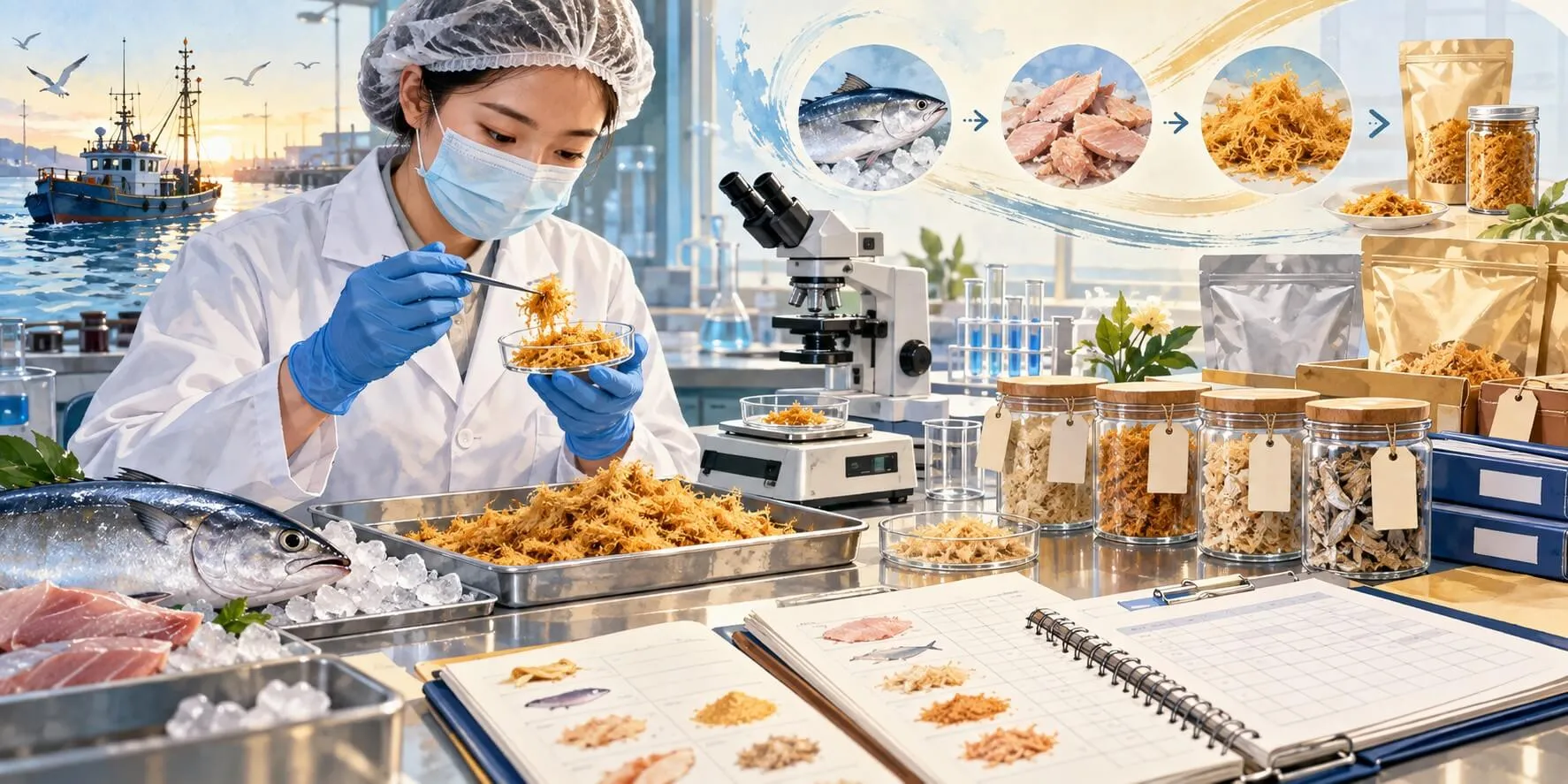
Establishing clear, documented quality standards and testing protocols with an OEM manufacturer, rather than relying on informal expectations, gives both parties an objective basis for evaluating whether production output consistently meets the brand's requirements across batches and over time.
1. Establish specific, measurable quality standards for flavor, texture, and appearance before production begins
2. Agree on testing frequency and methodology for ongoing quality verification across production runs
3. Define clear processes for handling quality deviations, including rejection criteria and corrective action expectations
Shelf-stable and ambient seafood snacks, including fish floss and dried seafood products
Frozen and chilled prepared seafood products for retail or foodservice distribution
Canned and retort-processed seafood products requiring specialized thermal processing capability
Private label seafood products for retail store brands and specialty food distributors
Evaluating a Seafood OEM Manufacturing Partner
Visit the production facility in person where possible, or request detailed virtual facility documentation
Request production samples and conduct independent quality and taste testing before committing to a production contract
Verify references from existing brand customers, particularly those in a comparable product category
Confirm minimum order quantity and lead time align with your business's realistic sales and inventory planning
Cost Structure and Pricing Transparency
Understanding how an OEM manufacturer structures pricing — including raw material cost pass-through, processing fees, and any minimum charges for smaller production runs — helps brands budget accurately and avoid surprises as raw material costs fluctuate, which is a genuine consideration for seafood given how much certain species' pricing can vary with seasonal availability and broader market conditions.
Clarify how raw material cost fluctuation, particularly for seasonal species, is reflected in ongoing pricing
Understand minimum charges or fees that may apply to smaller production runs below standard batch efficiency
Discuss whether pricing is quoted per unit, per batch, or through another structure relevant to your ordering pattern
Minimum Order Quantity and Production Scheduling
Seafood OEM manufacturers typically require minimum order quantities that reflect efficient production batch sizes for their equipment and processes, and brands should discuss these requirements realistically against their own sales forecasts and inventory capacity, since committing to volume beyond realistic near-term sales can create inventory and cash flow strain, particularly for perishable or limited-shelf-life products.
Traceability and Raw Material Sourcing Transparency
Seafood supply chains can involve multiple intermediaries between the original catch or farm and the finished processed product, making traceability documentation particularly important for brands facing increasing consumer and regulatory expectations around seafood sourcing transparency. Buyers should confirm their OEM manufacturer maintains and can share traceability records connecting finished product batches back to specific raw material sources and catch or harvest documentation.
Request traceability documentation connecting finished product batches to specific raw material sourcing records
Confirm the manufacturer can provide catch or harvest documentation relevant to sustainability certification requirements if applicable
Beyond the core product itself, many seafood OEM manufacturers offer varying levels of support for private label packaging development, and buyers should clarify what packaging design, printing, and regulatory labeling support is included versus handled separately by the brand or a third-party packaging supplier, since this affects both project timeline and total product development cost.
Clarify what packaging design and development support the manufacturer provides versus what falls to the brand
Confirm the manufacturer's experience with your specific packaging format and any special printing requirements
Discuss regulatory labeling compliance support for your specific target market's requirements
Common Mistakes When Sourcing a Seafood OEM Partner
Selecting a manufacturer based on general seafood processing reputation without verifying specific product category experience
Failing to clarify recipe and formulation ownership terms before significant joint development investment
Overlooking export certification requirements specific to the brand's actual target market
Committing to minimum order quantities that exceed realistic near-term sales and inventory capacity
Building a Long-Term OEM Manufacturing Relationship
Brands with growth ambitions should evaluate a candidate OEM manufacturer not just on current production needs but on their capacity and willingness to scale alongside the brand's growth, since switching manufacturing partners after a product has established market presence can introduce real quality consistency risk during the transition.
Evaluating a seafood OEM manufacturing partner requires verifying genuine product-category-specific production capability, confirming appropriate food safety certification, and establishing clear formulation ownership and quality testing agreements before significant commitment, rather than selecting a partner based on general reputation or price alone. Brands who build this verification into their supplier evaluation process consistently establish more reliable, lower-risk manufacturing relationships.
As demand for private-label and branded seafood products continues to grow across global markets, working with an OEM manufacturer who demonstrates genuine category expertise and transparent partnership terms offers brands a meaningfully stronger foundation for consistent product quality and reliable long-term supply.
Buyers who treat OEM manufacturer selection as a genuine due diligence process, rather than a simple price comparison, ultimately build the most durable and successful seafood product manufacturing partnerships.
Clarifying traceability practices, packaging development support, and cost structure alongside the core production and food safety fundamentals gives brands the fullest possible picture of what a manufacturing partnership will actually look like once regular production is underway.
Setting clear communication and development process expectations from the very first conversation, rather than discovering mismatched assumptions midway through a project, ultimately saves both the brand and the manufacturer significant time and helps establish the kind of trust that supports a genuinely long-term production partnership.
A manufacturer willing to walk a prospective brand through their traceability practices, cost structure, and development process in detail before a contract is signed is generally the stronger long-term partner for brands building a seafood product line meant to last.
Meta Description: A sourcing guide for brands evaluating a seafood OEM manufacturing partner, covering production capability verification, food safety certification, recipe and formulation ownership, and quality consistency testing.